

Most people assume a sore knee or stiff hip will heal the way a cut does. Cartilage does not work that way. The tissue that cushions your joints has very limited ability to repair itself once it is damaged, and that fact shapes how you should think about cartilage regeneration, daily joint care, and the supplements you choose. Cartilage injury and degeneration are among the most prevalent musculoskeletal disorders, affecting more than 500 million people worldwide. Here is what the research says, what it means for joint care in India, and where a daily supplement fits in.
Table of Contents
- Quick Takeaways
- Why Cartilage Cannot Repair Itself
- What Cartilage Regeneration Research Shows
- Clinical Trials and Emerging Treatments
- Where a Daily Joint Supplement Fits
- Comparing Joint Care Options That Actually Get Used
- Daily Habits That Protect the Cartilage You Have
- Frequently Asked Questions
- References
Quick Takeaways
| Key Insight | Explanation |
|---|---|
| Adult cartilage has almost no blood supply | Without blood vessels, damaged cartilage receives few repair cells, so small areas of wear often persist rather than heal. |
| Common surgical repairs rarely restore original tissue | Some established procedures produce fibrocartilage, which has weaker biomechanical properties than native cartilage. |
| Cartilage regeneration is still mostly experimental | Stem cell, cell-based and gene approaches are being tested in clinical trials, not offered as routine fixes. |
| Supplements support the joint, they do not rebuild it | Hyaluronic acid and chondroitin are used to support lubrication, cartilage health and daily mobility, not to regrow lost tissue. |
| Load management protects what you have | Repeated overloading of an irritated joint does more damage over time than a short period of modified activity. |
| Track stiffness and range of motion, not just pain | Cartilage has few nerve endings, so pain can lag behind wear. Longer morning stiffness and lost range of motion are earlier signals. |
Why Cartilage Cannot Repair Itself
Articular cartilage is the smooth, glossy tissue that covers the ends of your bones where they meet in a joint. It lets bones glide against each other with very little friction and spreads load across the joint surface. Once it is damaged, the body has a hard time putting it back together.
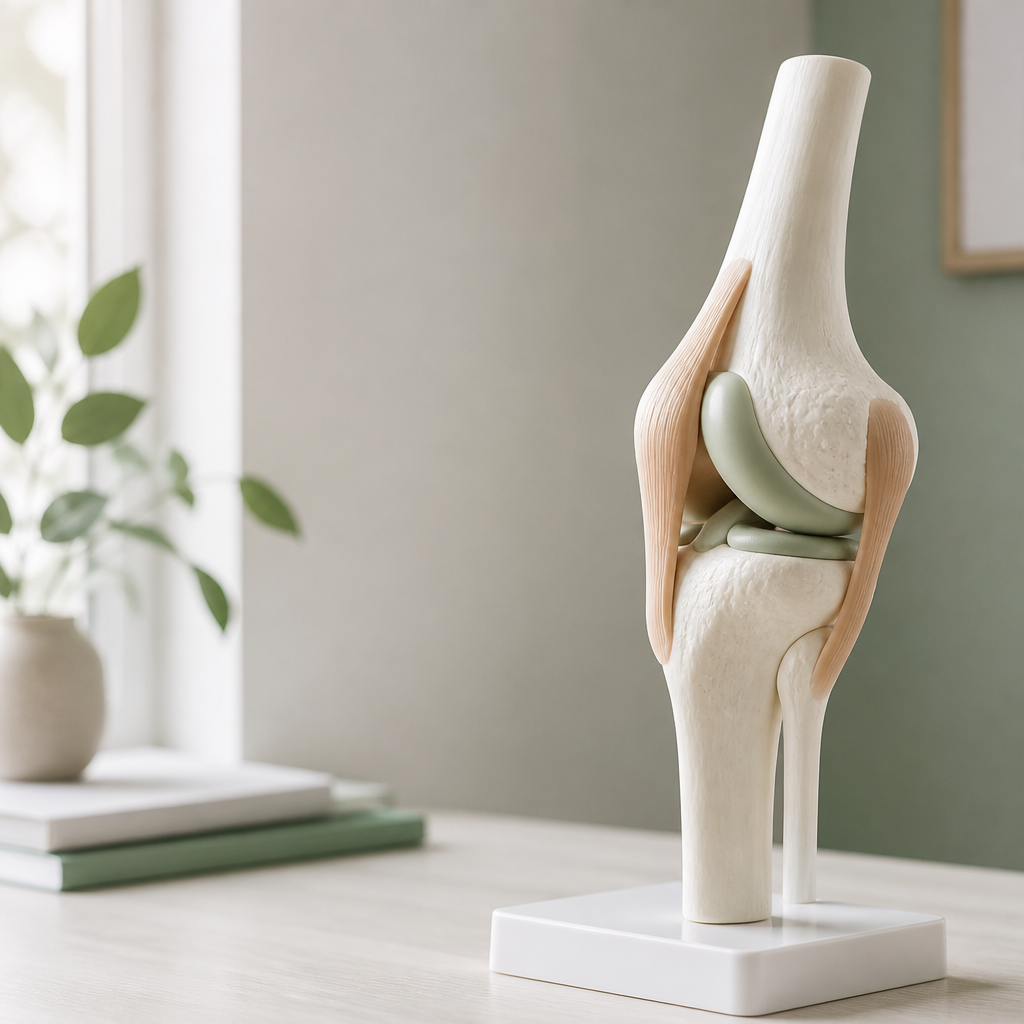
The main reason is blood supply. Healthy adult cartilage has no blood vessels of its own, so it depends on synovial fluid and the tissues around it for nutrients. The repair cells that rush to heal a cut or a torn muscle rarely reach a cartilage defect in meaningful numbers.
Why the missing blood supply sets the limit
Blood carries the cells, growth signals and building materials that drive healing elsewhere in the body. Cartilage gets very little of that. In practice, a small chip can sit unchanged for years while the bone beneath it and the lining of the joint react around it.
What happens when chondrocytes are lost
Chondrocytes are the cells that maintain cartilage, and there are relatively few of them spread through a dense matrix. When they die, the surrounding matrix cannot be rebuilt quickly. This is why a small area of wear can slowly spread across the joint surface over months and years.
Why small damage still deserves attention
A common mistake is to treat a joint as healed once the pain fades. Cartilage itself has very few nerve endings, so pain is an unreliable signal. A joint can feel fine while the cartilage underneath is still losing ground, which is why we recommend tracking stiffness and mobility rather than waiting for pain.
Pro tip: Keep a simple two-line log: how long your joint stays stiff after waking, and whether you can fully straighten and bend it. Changes over several weeks tell you far more than any single good or bad day.
What Cartilage Regeneration Research Shows
Cartilage regeneration is a serious research field, but it is not the same as a cure. A 2025 editorial titled Cartilage Repair in 2025: Hope, Hype, or Horizon? reviews the current landscape and gives a useful reality check for anyone hoping for a quick fix. It notes that cartilage injury and degeneration affect more than 500 million people worldwide.
The same editorial describes autograft transplantation, which moves healthy tissue from one place to another, as an effective option for focal defects, particularly in younger patients. It is limited, however, by donor-site morbidity, restricted graft availability, and a biomechanical mismatch with the surrounding joint. That is a sobering list for one of the more established techniques.
Autologous chondrocyte implantation and microfracture
Autologous chondrocyte implantation, usually shortened to ACI, uses a patient's own cells, grown outside the body and placed into the defect. The editorial calls ACI a major milestone but notes that it frequently results in fibrocartilage with inferior biomechanical properties compared with native tissue. Microfracture takes a different route by creating small access channels in the bone so the body's own cells can reach the defect.
Stem cell and gene approaches still in development
Stem cell therapies are attractive because of their ability to change into different cell types and to send signals that influence nearby tissue. The same editorial points to real hurdles, including cell engraftment, immune response and the potential for tumor formation. Newer work on skeletal stem cells and gene therapy is also under study, but these remain research topics rather than routine care.
Cartilage repair is not one technique. It is a set of trade-offs between how much tissue you restore, how much healthy tissue you give up to get there, and how well the repaired area holds up under daily load.
Clinical Trials and Emerging Treatments
Mayo Clinic's research listing for cartilage repair shows how wide the current pipeline is. Its six listed studies cover implants for knee lesions, cell-based treatments for focal hip defects, and a 12-year follow-up of arthroscopic meniscus surgery in osteoarthritis that tracks structural damage over time.

Read these listings with care. A trial exists to answer a question, and many of these studies are testing whether a treatment is safe and effective, not whether it works for everyone. Being listed does not mean a therapy is offered in your city or covered by your insurance.
Implants and cell-based repair in trials
One listed study compares the Agili-C implant with standard surgical care for joint surface lesions, including focal cartilage lesions, osteochondral defects and mild to moderate osteoarthritis. Another trial is testing autologous chondrons mixed with culture-expanded allogeneic cells for symptomatic focal cartilage defects of the hip, with MRI used to assess cartilage and bone structure. Both show how far the field has moved beyond simple surgery.
Early-stage research on activating natural repair
A pilot study registered on ClinicalTrials.gov evaluates a modified version of the ACT technique, called All Autologous Cartilage Repair. A news release from Duke's orthopaedics department also describes three experimental treatments designed to activate the body's natural repair processes in cartilage and the underlying bone. These are early steps, and the path from a pilot study to a routine clinic option is long.
Pro tip: If you are considering a clinical trial, ask the study team exactly what outcome is measured, how long follow-up lasts, and whether there is a comparison group. Those three answers tell you more than any headline.
Where a Daily Joint Supplement Fits
If cartilage cannot rebuild itself quickly, the practical question is what a daily product can realistically do. Our answer is narrow but useful. A daily supplement can support the joint environment you live in every day, but it cannot regrow tissue that has already been lost.
The role of hyaluronic acid in joint lubrication
Hyaluronic acid is a natural component of synovial fluid, the lubricating fluid inside joints. Revit Arthro uses Hyalutidin HC®, a high-purity hyaluronic acid, in a daily 30 mL liquid formula designed to support joint lubrication and everyday mobility. That is a support role, and it should be described as one.
Why chondroitin is paired with hyaluronic acid
Chondroitin is a component of cartilage's structural matrix. Revit Arthro combines it with hyaluronic acid to support cartilage health alongside lubrication, so the formula addresses both the fluid and the tissue. Anyone expecting a dramatic change within a few days will be disappointed, so judge the product over a consistent routine.
What a supplement cannot do for damaged cartilage
A supplement cannot replace a proper assessment of a locked joint, sharp pain on loading, or swelling that keeps returning. It also cannot offset a training plan that repeatedly overloads the same joint. The people who get the most from daily joint support are the ones who pair it with sensible movement and early medical checks.
Pro tip: Take your daily dose at the same time each day, tied to a habit you already have. Missed doses are the most common reason people decide a joint product has failed.
Comparing Joint Care Options That Actually Get Used
Most readers choose between three broad paths: a daily supplement, activity changes, or medical intervention. Each has a different job. The table below compares them the way we would explain it to a friend, focusing on what each option is for and where it falls short.
| Approach | Best Used For | Main Limitation |
|---|---|---|
| Daily joint supplement (hyaluronic acid with chondroitin) | Everyday stiffness and support for joint lubrication through a consistent routine | Does not regrow lost cartilage and does not replace a medical assessment |
| Load and movement changes | Reducing repeated overload and building strength around the joint | Requires consistency, can feel slow, and needs adjustment during flare-ups |
| Medical evaluation and procedures | Locked joints, persistent swelling, and defects that need structural treatment | More invasive or costly, and some newer options are still limited to specific cases |
Notice what is missing from that table: a single product that does everything. The best results come from combining the approaches, with a supplement as the daily base and medical advice as the checkpoint.
How to choose between them
Start with the symptom pattern. Morning stiffness that eases as you move often fits a daily support approach. Swelling, catching, or pain that wakes you at night calls for an in-person evaluation, and that call should not wait until the joint becomes a crisis.
Daily Habits That Protect the Cartilage You Have
Because cartilage cannot repair itself well, protecting what you have is the highest-return work you can do. The habits below are not glamorous, but they reduce the repeated stress that wears joints down over time. Whether you live in Delhi, Mumbai or Chandigarh, the basic principles are the same.

Managing load instead of avoiding movement
Rest is not the enemy, and total inactivity causes its own problems, because joints need regular movement to stay mobile. The goal is to manage load. Alternate harder days with lighter ones, and reduce repeated impact when a joint is already irritated.
Strength around the joint
Muscles that cross a joint share its load. Simple strengthening for the thigh, hip and calf muscles, done several times a week, can reduce how much stress reaches the cartilage surface. A common mistake is jumping straight to heavy exercise after a flare-up, which often restarts the cycle of pain and avoidance.
Weight, sleep and the stiffness you feel in the morning
Body weight changes the load on knees and hips with every step, so even modest changes can matter. Sleep affects recovery and how stiff you feel when you first stand up. Pay attention to whether your mornings are getting harder, because that trend tells you more than a single good or bad day.
Pro tip: Schedule one lower-impact day each week, such as cycling or swimming, and note how your joints feel the following morning. Over a few weeks, that log will show you what your cartilage tolerates.
Frequently Asked Questions
Can cartilage repair itself at all?
Adult articular cartilage has a very limited ability to repair itself, mainly because it has no blood supply and few repair cells. Small changes can sometimes stabilize, but significant damage usually does not return fully to its original structure.
Is cartilage regeneration available as a routine treatment in India?
Some surgical options, such as microfracture and cell-based implantation, are used in clinical practice, but many newer approaches are still mainly in trials. Ask an orthopaedic specialist in your city which options are available locally and suitable for your joint.
Does a hyaluronic acid supplement rebuild cartilage?
No. Hyaluronic acid supports joint lubrication and daily mobility. Revit Arthro combines it with chondroitin to support lubrication and cartilage health, but it does not regrow tissue that has already been lost.
How long should I take a joint supplement before judging it?
Judge it over a consistent routine rather than a few days. Keep a simple log of morning stiffness and range of motion so you can see trends rather than reacting to single days.
When should I see a doctor about joint pain?
See a doctor if a joint locks or catches, swelling persists, pain wakes you at night, or a joint gives way. These signs need an in-person assessment, and no supplement should delay that visit.
Can I take a joint supplement alongside other treatment?
Ask your doctor before combining any supplement with prescribed medicines or a treatment plan, especially if you are preparing for a procedure. A short conversation can prevent avoidable surprises.
Tell us in the comments what has helped your joints most so far, and what you wish you had known about cartilage sooner.


