

Most people only think about their joints when something goes wrong. You stand up after an hour at your desk and your knee complains for the first few steps, or your hip feels tight after a morning of errands. Behind that stiffness is a fluid most people have never heard of. Joint lubrication, supplied by synovial fluid, is what lets the smooth surfaces inside a joint glide past each other with very little friction. Understanding how this fluid works is the first step toward making sensible choices about joint care, whether you are 35 and active or 65 and noticing that mornings take longer than they used to.
Table of Contents
- Quick Takeaways
- What Synovial Fluid Actually Is
- How Joint Lubrication Reduces Friction
- Nourishing Cartilage Through Diffusion
- Why Joint Fluid Changes With Age and Use
- Comparing Ways to Support Joint Lubrication
- Where a Hyaluronic Acid Supplement Fits
- Daily Habits That Support Joint Fluid
- Common Mistakes With Joint Lubrication Products
- Frequently Asked Questions
- References
Quick Takeaways
Key Insight |
Explanation |
|---|---|
Synovial fluid is the working lubricant in synovial joints |
It reduces friction between the articular cartilage surfaces every time the joint moves, from a short walk to a full squat. |
Stiffness after sitting is a movement signal worth tracking |
Log how long stiffness lasts after you get up. A pattern that eases within minutes is different from one that drags on for hours. |
Cartilage depends on the fluid for nourishment |
Physiotherapy references describe synovial fluid nourishing cartilage through diffusion, so a joint that moves very little receives less of that exchange. |
Hyaluronic acid is central to fluid thickness |
Hyaluronan is a major component of synovial fluid and contributes to the viscous, slippery quality that keeps surfaces separated. |
Supplements support the system, they do not replace movement |
A daily liquid formula works best alongside regular low-impact activity and sensible body weight management. |
Persistent swelling, warmth or pain needs a clinician |
Symptoms that go beyond ordinary stiffness can have causes that a supplement cannot address, so they need a medical assessment. |
Judge a product by its ingredients and routine, not its promises |
Look for the named ingredient, the daily dose, and a label that explains what the product is intended to support. |
What Synovial Fluid Actually Is
Synovial fluid is the lubricant inside synovial joints, a group that includes the knee, hip, shoulder, elbow, and the small joints of the hand. Cleveland Clinic describes it as the lubricant in some of your joints, one that reduces friction and helps them move smoothly as they should. Most people never think about it until movement starts to feel like effort.
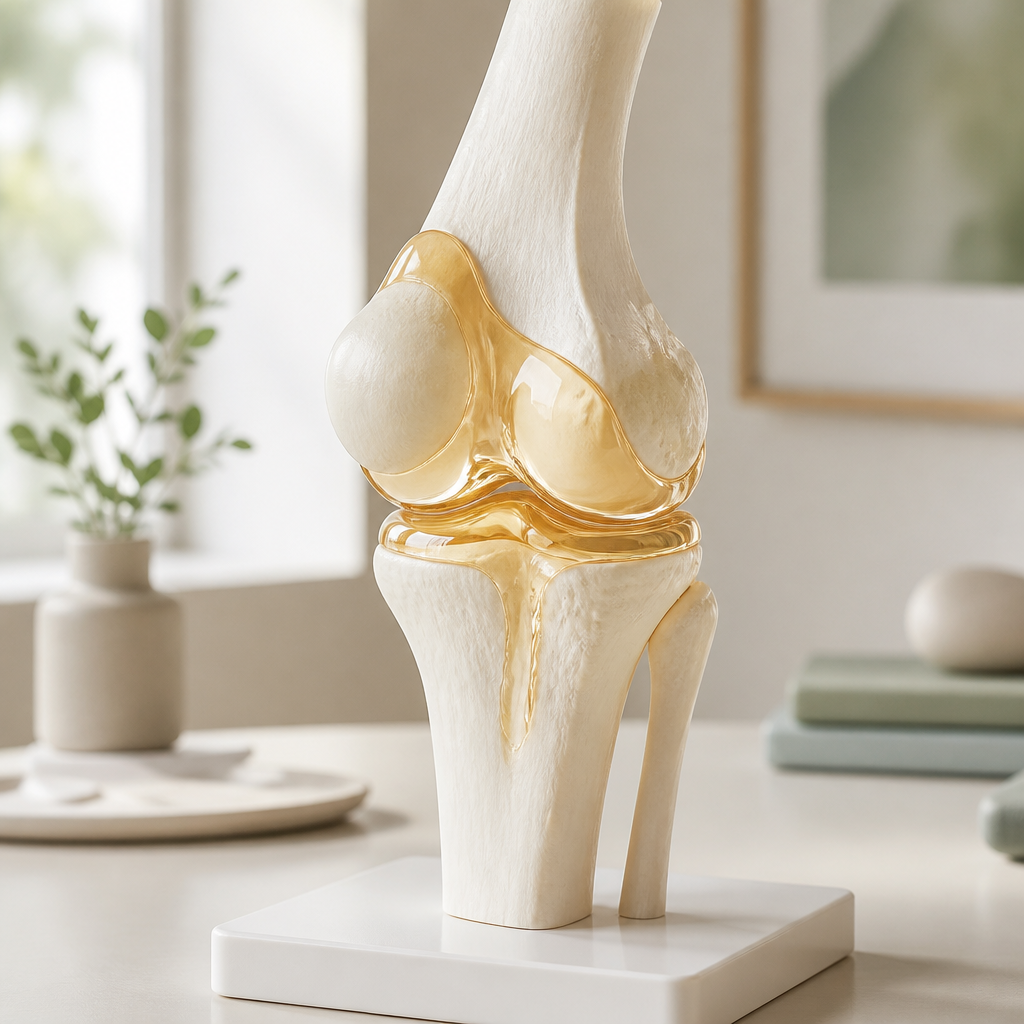
Where synovial fluid sits in the joint
The fluid fills the joint cavity, which is enclosed by a capsule lined with a thin synovial membrane. Inside that space, the ends of the bones are covered with articular cartilage, a smooth tissue that takes the load every time you step, bend, or lift.
Think of the arrangement as two hard but smooth surfaces separated by a thin film. The film keeps those surfaces from grinding against each other, and it is the part of the system that most affects how a joint feels during ordinary daily use.
The membrane that lines the capsule is responsible for producing the fluid. That is why inflammation or irritation inside the joint can change how the fluid behaves, and why the feel of a joint can shift even when nothing looks different on the outside.
What the fluid is made of
Synovial fluid is viscous, a property that researchers describe as providing lubrication to cartilage and joints with low-friction and low-wear characteristics, according to a ScienceDirect overview of the topic. Its thickness comes largely from hyaluronan, a long molecule made of repeating sugar units that holds water and gives the fluid its body.
Viscosity is a balancing act. The fluid must be thick enough to stay between the surfaces under load, yet fluid enough to move as the joint bends. When that balance shifts, movement can feel less smooth even if the joint is not damaged.
How Joint Lubrication Reduces Friction
The principal job of synovial fluid is to reduce friction between the articular cartilages of a joint during movement, according to a review of hyaluronan and synovial joint function hosted on PubMed Central. Every stride, reach, and twist asks two smooth surfaces to slide past each other. Without a working fluid film, that slide becomes rougher and more costly to the tissue.
Lubrication is not a passive coating. The fluid resists flow enough to stay in place under weight, yet it moves freely enough to let the joint bend. That balance is what makes joint lubrication work during real activity rather than only at rest.
Why cartilage needs a fluid film
Cartilage feels smooth to the touch, but at the microscopic level it still has texture and irregularity. When a joint carries weight, the fluid fills the gaps and takes on part of the load, which keeps the cartilage surfaces from contacting each other directly as often.
In practice, people notice this when a joint feels fine after a short warm-up but stiff after a long sit. That pattern usually reflects how the joint is being used and how the fluid is distributed through it at that moment, rather than a single cause.
A joint rarely fails all at once. It usually becomes a little harder to move well, one ordinary day at a time.
Low friction and low wear
The wear part of the equation matters more than most readers expect. Friction is what gradually erodes surfaces over years of use, so a fluid that keeps friction low also protects the tissue from slow damage.
Lower friction means each movement costs the joint less. Over thousands of steps, that difference adds up, which is why joint lubrication is best understood as a long-term maintenance question as well as a question of everyday comfort.
Pro tip: Pay attention to the first five minutes after you get up or stand from a chair. Note how long the stiffness lasts and whether a few slow, gentle movements ease it. That simple log gives you a baseline that is far more useful than a general sense that your joints feel off.
Nourishing Cartilage Through Diffusion
Cartilage is unusual because it does not rely on a rich direct blood supply the way most tissues do. Physiotherapy references explain that synovial fluid lubricates articular cartilage and also provides it with nourishment through diffusion, a slow exchange of nutrients and waste across the tissue. That makes the fluid a delivery route as well as a lubricant.
This is one reason a joint that moves very little can struggle. If the fluid is not regularly moved and renewed through normal motion, the cartilage receives fewer of the nutrients it depends on. The change is gradual and easy to miss, but it is real.

How nutrients reach cartilage
Diffusion moves molecules from areas of higher concentration to areas of lower concentration. In a joint, nutrients in the synovial fluid pass into the cartilage, while byproducts move the other way into the fluid. The process is slow, and it depends on the fluid staying in good condition.
For readers, the practical takeaway is that cartilage health is tied to the health of the fluid around it. Supporting the fluid is not a separate project from caring for the cartilage.
Why movement drives the exchange
Diffusion alone is slow, and joint motion helps circulate the fluid and spread it across the surfaces. This is why most practical advice on joint care includes regular movement, and it is why we position supplements as something that sits alongside activity rather than replacing it.
Low-impact activity such as walking, cycling, or swimming keeps load moving through the joint without the pounding that aggravates irritated tissue. The goal is steady motion, not exhaustion, and a joint that is used gently on most days usually tolerates more over time.
Why Joint Fluid Changes With Age and Use
Joint fluid does not stay the same across a lifetime. Viscosity, the thickness and resistance of the fluid, is what gives it a grip on the cartilage surfaces, and this property can change with age, injury, and long periods of inactivity. Many adults in their fifties notice joints that feel different from how they did in their twenties, even when their daily activity looks similar on paper.
Age is only part of the story. Many adults who sit for most of the workday, such as an accountant in Mumbai or a software engineer in Bengaluru, find that their joints feel stiffer by the end of the week than they did at the start. Less movement means less circulation of the fluid, and that pattern often shows up in how a knee or hip feels when they first stand.
Viscosity and why it can thin
Hyaluronan is a major contributor to the thickness of synovial fluid. When the fluid is less viscous, it may not hold the film between surfaces as effectively, which can make movement feel less smooth. The changes vary from person to person, and they are not always visible from the outside.
This is why you should not judge joint fluid by appearance alone. Swelling is a separate issue. The first sign is often a sensation of drag or resistance rather than any visible change, which is why a simple daily log is more reliable than memory.
Morning stiffness versus persistent discomfort
Some stiffness after rest is normal and usually eases within a short window of gentle movement. What deserves attention is stiffness that lasts much longer, returns with the same intensity every day, or arrives with swelling, warmth, or pain that does not settle.
Keep those two patterns separate in your mind. Everyday stiffness is a reason to start moving and to consider daily support. Persistent or worsening symptoms are a reason to speak with a clinician, because the cause may be something a supplement cannot address.
Comparing Ways to Support Joint Lubrication
Anyone trying to support joint lubrication has several realistic options, and they are not interchangeable. Each one addresses the system from a different angle, and each carries a different cost in time, money, and commitment. Comparing them honestly helps you decide what fits your situation.
The table below compares a daily oral hyaluronic acid liquid, an oral chondroitin and glucosamine capsule, and a clinician-administered hyaluronic acid injection. These are approaches rather than brand comparisons, and none of them replaces regular movement.
Approach |
What It Targets |
Practical Trade-off |
|---|---|---|
Daily oral hyaluronic acid liquid |
Supports the hyaluronic acid content of synovial fluid as part of a daily routine |
Easy to take each day, but benefits depend on consistency, and it is a supplement rather than a medical treatment |
Oral chondroitin and glucosamine capsules |
Supports cartilage structure and joint comfort through ingredients common in joint formulas |
Pill-based routine, research results vary between people, and anyone taking blood thinners should check with a clinician first |
Clinician-administered hyaluronic acid injection |
Delivers hyaluronic acid directly into the joint space |
Requires a medical assessment and a clinic visit, and it belongs to a different category of care than a daily supplement |
How to read the table
The first row is the one most relevant to a daily routine. It asks very little beyond consistency, which is also why it is easy to abandon after two weeks. If you are going to try it, set a fixed time each day and keep notes.
The third row should not be compared on price alone. A clinic procedure involves medical judgment that no liquid can replace. For people with significant pain or limited mobility, that conversation should come before any product decision.
Choosing between them
Our view is that a daily formula makes sense for people dealing with everyday stiffness, provided they also keep moving. It does not make sense as a substitute for a medical assessment when symptoms are serious. If stiffness still limits daily life after a consistent trial, the right next step is a doctor or physiotherapist, not a stack of additional products.
Where a Hyaluronic Acid Supplement Fits
A hyaluronic acid supplement makes sense when the goal is daily support for everyday joint stiffness, not treatment of an established condition. The logic is straightforward: hyaluronic acid is a core part of synovial fluid, so a formula that supports it fits naturally into a routine focused on lubrication. The research on oral intake and its effects is still developing, so expectations should stay realistic.
Revit Arthro is formulated by RevitNature, a German-engineered wellness company, and combines Hyalutidin HC®, a high-purity hyaluronic acid, with chondroitin. It is designed for daily mobility support in a 30 mL liquid format. The product is a supplement, and it does not claim to cure joint disease or replace medical care.

What Hyalutidin HC is designed to do
Hyalutidin HC® pairs hyaluronic acid with chondroitin, two ingredients associated with synovial fluid and cartilage. The aim is to support joint lubrication and cartilage health from the inside, without injections. Think of it as a daily input to a system you already have, not a fix for a damaged joint.
Chondroitin is a component of cartilage, while hyaluronic acid is a major part of the fluid that surrounds it. Pairing them targets both the lubricant and the tissue it protects, which is the reasoning behind the formula.
Using a 30 mL daily liquid well
A liquid format suits people who dislike swallowing pills or who want a measured daily habit that is easy to track. Take the 30 mL daily dose at the same time each day, ideally attached to a routine you already have, such as breakfast or a morning walk.
Give the routine a fair test before judging it. Two weeks of inconsistent use will not tell you much, but a steady month with notes on morning stiffness and how far you can walk gives you real information to act on.
Daily Habits That Support Joint Fluid
Supplements work best when the rest of the day supports joint motion. The habits below are simple and need no special equipment. They matter more than most people expect because they determine how often the fluid is actually moved through the joint.
None of these habits is dramatic, and that is the point. Joint lubrication responds to repeated, ordinary movement far more than to occasional heroic effort.
Movement that keeps fluid moving
Short, frequent movement beats one long session once a week. Standing up every half hour or so during desk work, walking after meals, and doing ten minutes of gentle range-of-motion exercises keep joints from going still for too long. This matters for a teacher in Pune or a designer in Chandigarh who spends most of the day seated.
Strength work for the muscles around the joint also helps. Stronger muscles share the load, which reduces how hard the joint itself has to work. Cycling, swimming, and stationary cycling are good low-impact starting points if you are unsure where to begin.
Weight, hydration, and sleep
Body weight changes the load on weight-bearing joints such as the knees and hips. Even modest changes can make daily movement feel easier, which encourages more motion and therefore more fluid circulation. Staying hydrated supports overall tissue health, although no single drink will change joint fluid on its own.
Sleep matters because joints recover during rest, and stiffness is often most noticeable after a poor night. Keep a consistent bedtime, and avoid staying in one position for hours when you can, since a body that has been completely still can make the first steps of the morning feel harder.
Pro tip: Set a reminder to stand and move for two minutes every hour during work. Attach it to a task you already do, such as refilling your water bottle, so the habit happens without relying on willpower.
Common Mistakes With Joint Lubrication Products
Most of the problems people report with joint products come from how they use them, not from the products themselves. These are the mistakes that come up most often when people talk about joint care, and each one has a straightforward fix.
Recognizing them early saves months of frustration, and it helps you separate a product that is not working for you from a routine that was never given a fair chance.
Expecting a change within days
The most common mistake is judging a daily formula after a few days. Joint fluid and cartilage do not change on a schedule that matches a marketing timeline. Commit to a consistent routine, keep a simple log, and review it after several weeks.
A log does not need to be elaborate. Record morning stiffness on a scale you define yourself, along with any days when movement felt noticeably easier or harder.
Ignoring warning signs
Some people treat persistent swelling, warmth, locking, or sharp pain as normal wear and continue with supplements alone. That is a mistake. Those signs can point to causes that need medical evaluation, and a supplement should never delay that visit.
Also avoid stacking many joint products at once. When you change several things together, you cannot tell what is helping or what is causing a side effect. Change one thing at a time and give it a fair window before deciding.
Pro tip: Before starting any new supplement, write down your current medications and any blood thinners, then review that list with your doctor or pharmacist. This matters most for people managing other long-term conditions.
Frequently Asked Questions
What is synovial fluid and what does it do?
Synovial fluid is the viscous lubricant inside synovial joints. It reduces friction between the articular cartilage surfaces during movement and helps nourish cartilage through diffusion.
Can a supplement improve joint lubrication?
A supplement can provide ingredients such as hyaluronic acid that are part of synovial fluid, which is why many formulas focus on lubrication. It cannot rebuild a damaged joint, and results vary from person to person, so treat it as daily support rather than a cure.
How long should I take a joint supplement before judging results?
Give a consistent daily routine several weeks before deciding whether it helps. Keep brief notes on morning stiffness and how far you can walk, because memory is unreliable for gradual changes.
Is stiffness after sitting always a sign of a problem?
Not always. Short-lived stiffness that eases with gentle movement is common. Stiffness that lasts a long time, gets worse, or comes with swelling, warmth, or pain should be checked by a clinician.
Can I take a hyaluronic acid supplement with other medicines?
Ask your doctor or pharmacist before starting any supplement, especially if you take blood thinners or medicines for other long-term conditions. Bring the product label so they can check the ingredients against your prescriptions.
Is joint lubrication the same as pain relief?
No. Lubrication describes how smoothly a joint moves, while pain has many possible sources. A joint can move more smoothly and still hurt, so pain needs its own assessment.
We would like to hear from you, so share with the RevitNature team which part of your daily routine makes your joints feel stiffest and which changes have helped you most.
References
Cleveland Clinic overview of what synovial fluid is and how it functions
Review of hyaluronan and its role in synovial joint function and distribution
Physiotherapy reference on the synovium and how synovial fluid nourishes cartilage
ScienceDirect overview of synovial fluid viscosity and low-friction lubrication


