

Dussehra rarely feels like a single strenuous day. It is a run of errands, cooking, family visits, and evening outings that stretches across a week or more, and your joints absorb every step of it. Knees, hips, and ankles carry body weight through walking, stair climbing, and standing, so the total load rises quickly even when each activity feels ordinary. This guide explains why joint fatigue during the festive season builds up, which habits make it worse, and what you can change without giving up the celebrations.
Table of Contents
- Quick Takeaways
- Why Festive Activity Strains Your Joints
- Long Hours on Your Feet at Pandals and Family Events
- Cold Weather and Morning Stiffness
- Sweets, Meals and Inflammation During Festivities
- Sleep, Hydration and Recovery Between Events
- Pacing, Movement and Recovery Routines
- Where a Joint Support Supplement Fits
- Frequently Asked Questions
- References
Quick Takeaways
| Key Insight | Explanation |
|---|---|
| Festive fatigue is mostly cumulative load | Dussehra weeks combine walking, standing, lifting, and short nights, so the strain builds over days rather than in one event. |
| Standing still can be harder than walking | Long periods on hard floors or at pandals keep the knees and hips under constant load with little movement to spread lubrication. |
| Cold mornings increase stiffness | Cooler temperatures can make joint fluid thicker, so warm up slowly before you get out of bed or head out after a late night. |
| Meal timing matters as much as sweets | Skipping meals and then eating a heavy dinner can leave you feeling sluggish, so keep protein and vegetables on your plate every day. |
| Keep low-impact movement going | Aim for about 30 minutes of walking, cycling, swimming, or gentle yoga, split into shorter blocks on busy days. |
| Plan one lighter day into the schedule | Protect a recovery day after the heaviest run of events, and keep your wake time steady during late-night celebrations. |
Why Festive Activity Strains Your Joints
Most festive joint complaints do not start from nothing. The festival season exposes joints that were already working near their limit and pushes them past it. Many adults who feel only mild stiffness in ordinary months notice it climbing once the calendar fills with events.
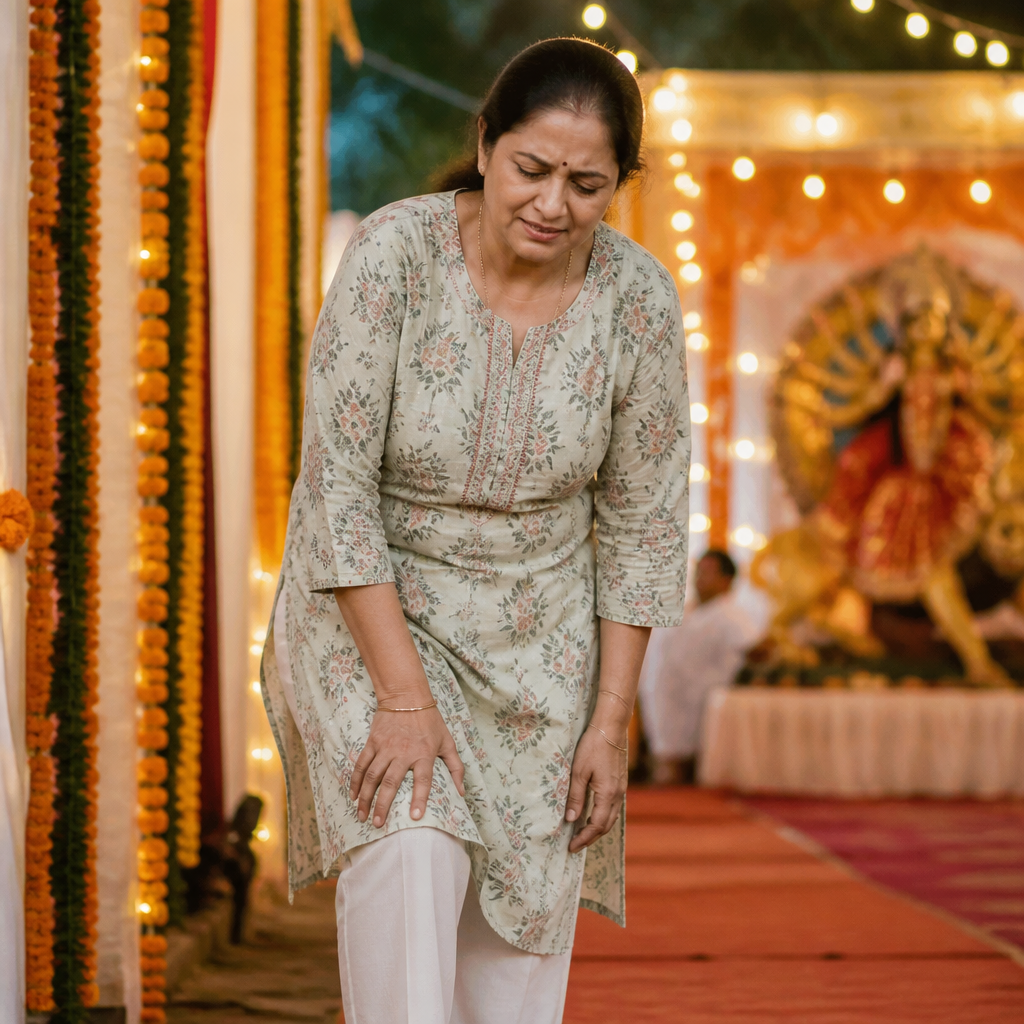
In our experience, the problem is rarely one dramatic day. A morning of heavy cleaning followed by an evening at a pandal can feel manageable on its own, but repeat that pattern for five or six days and the joints never get a clean recovery window.
How Cumulative Load Builds Across the Week
Fatigue accumulates in a predictable way. The stiffness that used to fade by midday starts lingering into the afternoon, and by the end of the week you feel heavy on the stairs and slow to get up from the floor. Each extra event adds a little more load before the last one has settled.
The practical fix is to plan around the whole week, not the single day. Count how many hours you spend on your feet, how many flights of stairs you climb, and how many late nights you string together. Cumulative load is usually the real cause of festive joint fatigue.
Why Joints Feel Strain Before Muscles Do
Muscles often recover faster than the structures around a joint. Once a joint starts to feel grinding or heavy after activity, the cushioning and lubrication that keep movement smooth have been stretched thin. That is why many people describe festive fatigue as a stiff, unsettled feeling in the joint rather than ordinary muscle soreness.
Long Hours on Your Feet at Pandals and Family Events
Standing still for long stretches is one of the most underrated sources of joint strain during festivals. Pandal visits, crowded temple queues, and family gatherings often mean standing on hard floors or uneven ground with little chance to shift your weight. Standing keeps the knees locked and the hips under steady load, which tends to leave joints tighter than a brisk walk of the same length would.
Standing Versus Walking
Walking keeps fluid moving through the joint because each step asks it to bend and straighten. Standing in one place requires muscle tension without that regular motion. If you have to stand, shift your weight every few minutes, keep your knees slightly soft, and step away for a short loop when you can.
Footwear matters more than most people expect. Worn-out chappals or flat, unsupportive shoes on marble floors push force into the knees and ankles. A cushioned shoe with a stable heel is a better choice for a long evening out, even if it does not match the outfit.
Carrying, Kneeling and Lifting During Rituals
Festivals bring their own physical demands. Carrying children, shopping bags, or serving trays puts sudden load through the shoulders, lower back, and knees. Kneeling for prayers, sitting on the floor, and getting back up repeatedly stress the knees and hips, especially if you already notice stiffness when rising from a chair.
A common mistake is trying to do everything in one trip. Split heavy loads into smaller batches, ask someone else to handle the lifting, and use a low stool or cushion when you need to sit on the floor. These small changes reduce peak strain without asking you to skip the rituals.
Pro tip: Keep a small folding stool in your bag or car. It gives you a place to sit between events so you are not standing in one spot for an hour.
Cold Weather and Morning Stiffness
Dussehra falls as the weather starts to change across much of India, and cooler evenings and early mornings can make joint complaints worse. Many people notice the most stiffness on the morning after a late event, when they have spent time in cool night air and then slept in one position. The change in temperature is not just uncomfortable. It affects how the joint moves.
What Happens Inside a Joint in Cooler Weather
An orthopaedic surgeon at UT Southwestern explains in a MedBlog post that synovial fluid, which is key to maintaining range of motion, gradually decreases as we age. The same post notes that in colder temperatures with low barometric pressure, that fluid expands and thickens, which increases inflammation and makes joints less mobile. Pair that with a body working harder to stay warm, and stiffness is almost predictable.
Cartilage cushions the ends of the bones, and it depends on smooth movement inside the joint to stay comfortable. When lubrication thins out and movement slows, the joint has less room for error. A slow start to the day matters more during a cold festival week than during a mild month.
Warming Up Before the Day Starts
Get out of bed in stages. Sit on the edge of the bed, move your ankles and knees in small circles, and stand only after the first stiffness begins to ease. Five minutes of gentle movement before your first trip out often helps more than a hard workout later in the day.
Most festive joint complaints do not come from one bad day. They come from several reasonable days stacked on top of each other, with too little recovery in between.
After late-night events, keep your knees and shoulders covered if you feel a draft, and avoid sitting in a cold car or open outdoor space for long periods. A warm shower in the morning can ease the first wave of stiffness. These are simple habits, but they make the cold days far more manageable.
Sweets, Meals and Inflammation During Festivities
Sweets are everywhere during Dussehra, and most families do not want to say no to a plate of mithai offered at every door. The goal is not to cut out festive food. It is to stop sugar-heavy, fried, and irregular meals from taking over the whole week, because for many people those patterns make joint discomfort feel worse.
Holiday Treats and Omega-3 Foods
A holiday joint health guide from a Florida orthopaedic provider recommends foods rich in omega-3 fatty acids, such as salmon and walnuts, along with antioxidant-rich berries and leafy greens. Those foods fit a festive household well because they can be added to ordinary meals without changing the celebration. Walnuts make a useful snack between events, and a serving of spinach or seasonal greens can balance a heavy dinner.
Most Indian households already eat dal, vegetables, curd, and seasonal fruit. Keep that base steady and treat sweets as an addition, not a replacement. When you eat a rich sweet, have it after a meal with protein and vegetables instead of on an empty stomach.
Portion Habits That Actually Work
Portion control works better when it is planned. Serve yourself a small plate of sweets, then move the tray out of easy reach. Drinking a glass of water before you eat helps you judge hunger more accurately, which keeps dinner from turning into a second round of sweets.
A common mistake is skipping lunch to save appetite for a big evening event. A long gap followed by a heavy, late meal can leave you feeling sluggish the next morning, and that heaviness often shows up as stiffness. Eat something steady at regular intervals instead.
Sleep, Hydration and Recovery Between Events
Late Nights and Joint Recovery
Renova Hospitals' guide to managing chronic conditions during festivals in India lists not compromising on sleep among its practical recommendations. Sleep is when the body does much of its repair work, and a week of short nights tends to make every joint feel heavier the next day.
Festive schedules rarely allow a full night's sleep. If late events push your bedtime past midnight for several nights, protect one fixed wake time and take a short afternoon rest instead of shifting your whole sleep cycle. Keep the bedroom cool, place a pillow between the knees if you sleep on your side, and avoid heavy meals in the hours before bed.
Fasting Days and Fluid Intake
Many households observe fasts or partial fasts during the Navratri and Dussehra period, and fasting can quietly cut fluid intake. Less fluid means less of the lubrication that keeps joints moving smoothly, so stiffness can feel worse on fasting days. The same festival health guidance also lists staying hydrated as a key step.
Plan fluids around your fast rather than trying to catch up at night. Coconut water, buttermilk, and plain water in measured amounts between meals are easier on the stomach than a large glass just before bed. If your fast is medically restrictive for you, ask your doctor what is safe before you begin.
Pro tip: Set a phone reminder to drink a glass of water after every event you attend. Festival days blur together, and most people drink far less than they plan to.
Pacing, Movement and Recovery Routines
The most useful festive joint plan is not a rigid exercise program. It is a simple pattern of pacing, low-impact movement, and deliberate recovery built around your event calendar. One arthritis guidance piece on festivities notes that this time of year may bring increased joint pain, fatigue, and the risk of flare-ups for people living with arthritis, which is why planning ahead matters.
A Simple Pacing Plan for Festival Days
Pacing means spacing out demanding tasks so you never run through the whole day at full effort. Do the heaviest jobs, like cleaning or cooking large batches, in the morning when joints are usually less stiff, and keep evenings for lighter social time. Sit down between tasks, even for five minutes.
Pacing works best when you choose one anchor activity each day, the event you cannot skip, and let the rest flex around it. If the day includes two long events, pick the one that matters most and shorten the other. People who try to attend everything often pay for it with two days of stiffness.
Low-Impact Movement That Fits Festival Schedules
Low-impact activity keeps joints moving without heavy pounding. Brisk walking, cycling, swimming, and gentle yoga are the options most often recommended. A Florida orthopaedic guide suggests aiming for at least 30 minutes of movement daily, even if you break it into smaller segments. During Dussehra, a 10-minute walk after lunch and another after dinner can count toward that target.
Avoid trying to make up for lost activity with one hard session. A sudden burst of high-impact exercise on a tired joint usually produces more soreness, not less. Keep the effort moderate and let consistency do the work.
Where a Joint Support Supplement Fits
Movement, pacing, and sleep form the foundation, and no supplement replaces them. For people who want extra daily support for joint lubrication and cartilage health, a liquid joint supplement can sit alongside those habits. Revit Arthro is a German-engineered liquid joint supplement designed for daily mobility support, which makes it a practical addition to a steady routine.
What Revit Arthro Is Designed to Do
Revit Arthro is a daily 30 mL liquid formula built around Hyalutidin HC®, a high-purity hyaluronic acid combined with chondroitin. It is designed to support joint lubrication and cartilage health as part of everyday care, from the stiffness you feel after resting to the fatigue that builds on active days. It is not a painkiller and it does not replace medical advice for joint conditions.
During a festive week, consistency is the hardest part. A liquid format is easy to fit into a morning routine, even when you are moving between family homes. Keep the bottle somewhere you will see it, such as beside your breakfast things, so the habit does not depend on memory.
Comparing Your Options During Festive Weeks
No single approach covers every festive joint problem. The table below compares the three approaches people most often rely on during busy weeks, and where each one falls short.
| Approach | Best For | Main Limitation |
|---|---|---|
| Scheduled pacing and rest | Long event days that involve standing and lifting | It does not reduce the demands of the events themselves, so it needs planning before the week starts. |
| Daily low-impact movement | Morning stiffness that eases with a warm-up and gentle walking | It takes time every day, and festival schedules often squeeze that time out first. |
| Daily liquid joint supplement (Revit Arthro, 30 mL) | Steady daily joint support alongside movement and rest | It works as part of a routine rather than as an instant fix for a flare-up, and it is not a substitute for medical care. |
Our recommendation is to combine all three. Pacing protects your joints on the heaviest days, movement keeps them mobile, and a daily supplement gives the routine a steady base. If joint pain is severe, persistent, or affects your sleep or walking, see a doctor rather than waiting for the festival to end.
Frequently Asked Questions
Why do my joints feel worse during the festive season?
Festive weeks combine longer hours on your feet, more lifting and kneeling, cooler mornings, irregular meals, and disrupted sleep. Each factor is manageable alone, but together they add up, which is why joint fatigue often builds over several days.
Is joint pain during festivals in India a sign of something serious?
Mild stiffness that eases with movement is usually a load and recovery issue. Pain that is severe, swollen, or hot, that does not settle after the festival period, or that affects walking or sleep should be checked by a doctor.
What is the best way to reduce joint fatigue during festivals?
Plan the week around one or two anchor events, schedule rest between heavy tasks, keep daily low-impact movement going, and protect your sleep. These steps work better together than any single change.
Can a joint support supplement help during Dussehra and Navratri?
A joint support supplement can be a steady part of a daily routine aimed at joint lubrication and cartilage health. It works best alongside movement, pacing, and good sleep, and it should not be used to push through pain. Check with your doctor first if you take other medicines.
What should I eat during festive days to protect my joints?
Build meals around protein, vegetables, dal, curd, and fruit, and treat sweets as an addition rather than a replacement for regular food. Meal timing matters too, since skipped meals can make stiffness feel worse the next morning.
Should I stop exercising during the festival week?
No, but reduce the intensity. Keep 20 to 30 minutes of walking or gentle movement on most days, and skip high-impact sessions on days with heavy standing or late nights.
Tell us in the comments which festive habit has helped your joints the most, and which one you wish you had started sooner.
We would love your feedback and any insights you would share with others. What perspective would you add?


