

Most people who spend their workday in a chair never think about their joints. The stiffness shows up later, when you stand after a long meeting and your hips protest every step. Prolonged sitting joint damage is less dramatic than an injury, which is why it gets ignored. The joints that carry weight and move through a full range are left still for hours, and the tissues around them adapt to that stillness. This article explains what sitting too long does to your joints, why office joint pain often starts in the lower back and hips, and which changes actually help. It also covers where a daily joint support supplement fits and where it does not.
Table of Contents
- Quick Takeaways
- What Prolonged Sitting Does to Your Joints
- Why Joint Stiffness Hits Hardest When You Stand Up
- Office Joint Pain: Where It Usually Starts
- Sedentary Lifestyle and Joint Health Beyond the Desk
- Setting Up Your Workstation to Protect Your Joints
- Movement Breaks That Actually Reduce Stiffness
- Where a Joint Support Supplement Fits In
- Comparing Three Approaches to Sitting-Related Joint Stiffness
- Frequently Asked Questions
- References
Quick Takeaways
| Key Insight | Explanation |
|---|---|
| Stiffness is a stillness problem | Joints and the tissues around them are designed to move. Long stretches of sitting make them stiff, and the discomfort often appears the moment you stand. |
| Lower back and hips take the first hit | Prolonged sitting with poor posture overloads the muscles of the back and spinal ligaments, and low back pain is the most consistently linked problem. |
| Break the sitting every 30 to 60 minutes | A brief stand and walk resets joint position. This is a practical starting point, and it matters more than a single long workout. |
| Set up the chair and feet first | Keep your back supported, feet flat on the floor, and a small gap between the back of your knees and the seat edge. |
| Stretch before you stand up | Seated hip and hamstring stretches before your first steps make the transition from sitting to walking far more comfortable. |
| Supplements support, they do not replace movement | A daily joint support routine works best alongside movement breaks and better posture, not instead of them. |
| The risk extends beyond your joints | Mayo Clinic guidance notes that sitting for long periods seems to raise the risk of death from heart disease and cancer, so fixing joints alone is not enough. |
What Prolonged Sitting Does to Your Joints
Joints are built to move. Cartilage has no blood supply of its own, so it depends on the rhythm of loading and unloading to exchange fluid and nutrients with the joint around it. When you sit still for hours, that rhythm disappears.
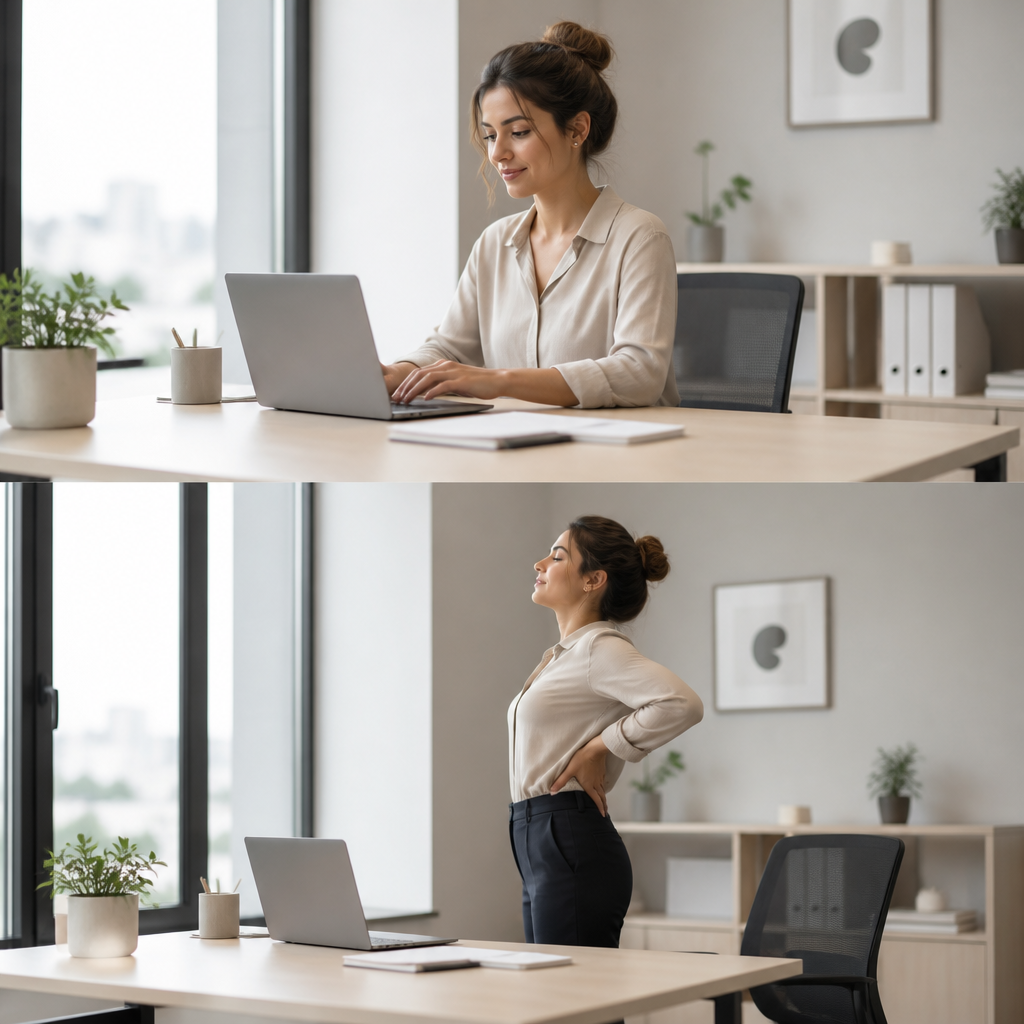
Sitting also holds the knees bent and the hips flexed for long stretches. The muscles around those joints settle into shortened positions, and the soft tissue adapts to the position you spend most of your day in. Orthopedic guidance describes this plainly: sitting for long periods makes joints stiff, which can cause discomfort and pain when you finally get up and move around.
Cartilage needs movement to stay nourished
Think of cartilage as a sponge that gets compressed and released. Movement creates the pressure changes that help fluid move in and out of the tissue. Long stillness does not cause an injury on its own, but it removes the cycle the tissue is built around.
This is why a joint can feel fine during a stressful meeting and then lock up the moment you stand. In practice, the people who notice this most are often active people with sedentary jobs. Regular training helps, but it does not fully cancel out eight hours of stillness.
Stiffness that builds across a working day
Stiffness rarely arrives in one dramatic moment. It accumulates. Morning mobility is usually reasonable, mid-afternoon feels heavier, and by the end of the day the hips and knees need a deliberate warm-up. A common mistake is to treat this as normal aging and wait for it to pass. The better reading is that it reflects how your day is structured, and that structure is something you can change.
Why Joint Stiffness Hits Hardest When You Stand Up
The worst moment is usually the first few steps after a long sitting session. Many people describe a lock that loosens after a minute or two of walking. That pattern is typical of joint stiffness after sitting, and it tells you something useful: the joint was not moving through its range, so the first movements have to restore it.
The first steps after a long meeting
When you stand, your body suddenly takes weight through joints that have been held in one position. The hip flexors feel short, the knees resist full extension, and the lower back may ache until you walk around. In practice, stand up slowly, shift your weight from foot to foot, and take a few gentle steps before you climb stairs or lift anything.
Stiffness after sitting is usually a sign that a joint has been unloaded, not proof that it has been damaged. The problem is repetition. The same stillness, day after day, is what turns a temporary ache into a pattern the body starts to protect.
Why hips and knees feel it most
Hips and knees carry the most noticeable stiffness because they spend the most time bent during sitting. The knee stays in flexion for the whole session, and the hip stays flexed too. When you finally extend them, the tissues have to lengthen quickly, and that is where the discomfort shows up. Ankles stiffen as well when feet are tucked under the chair for hours, which can make the first steps feel unsteady.
Office Joint Pain: Where It Usually Starts
Office joint pain is rarely random. It follows the posture most people hold at a desk: head forward, shoulders rounded, lower back slumped or pushed to one side, and legs parked wherever the chair leaves them. Each of these positions loads a different set of joints and tissues.
Lower back and spinal discs
The lower back takes the heaviest load in most seated postures. A review of prolonged sitting behavior found that it raises the risk of musculoskeletal disorders, especially low back pain. MemorialCare describes how prolonged sitting with poor posture overworks the muscles of the neck, back, and spinal ligaments, which strains the discs and the structures around them.
In practice, desk-related low back pain often starts as a dull ache after lunch and turns sharp when you bend to pick something up. If you notice that pattern, the fix is usually posture and movement, not waiting for the ache to fade.
Neck and shoulders from screen posture
Screen work moves weight forward. When the head sits in front of the shoulders for hours, the neck muscles work harder just to hold it up. Shoulders round to match, and the upper back stiffens. Many people feel this as a tight band across the shoulders by mid-afternoon, long before they notice any joint pain.
Knees, hips, and ankles under the desk
Knees and ankles rarely get blamed, but they are part of the same chain. Crossing your legs for long periods shifts the pelvis and loads one hip more than the other. Feet that dangle off a chair that is too high can also pull on the back of the thigh, which changes how the knee and ankle move when you finally stand.
Sedentary Lifestyle and Joint Health Beyond the Desk
A desk job is only part of the picture. Many people sit on the commute, through lunch, on the sofa after work, and in front of a screen again before bed. The total number of sitting hours matters more than the time spent at the office alone.
Total sitting time adds up
Mayo Clinic guidance notes that sitting for long periods seems to raise the risk of death from heart disease and cancer. That is a broader health issue than joints, but it comes from the same behavior. A sedentary lifestyle is a whole-body pattern, so changing only your chair leaves the larger problem in place.
Evenings and weekends can undo daytime effort
Someone who takes short walks at work but spends the evening on the sofa with legs tucked underneath may still wake up stiff. A common mistake is to believe that one good workout cancels a day of sitting. It helps, but when stillness is the default, joints respond more to how often you move than to how hard you move once.
Setting Up Your Workstation to Protect Your Joints
Ergonomics will not fix a sedentary day, but a badly set up chair can make every hour of sitting harder on your body. The fundamentals are simple, and most offices never check them.
Chair height, back support, and foot position
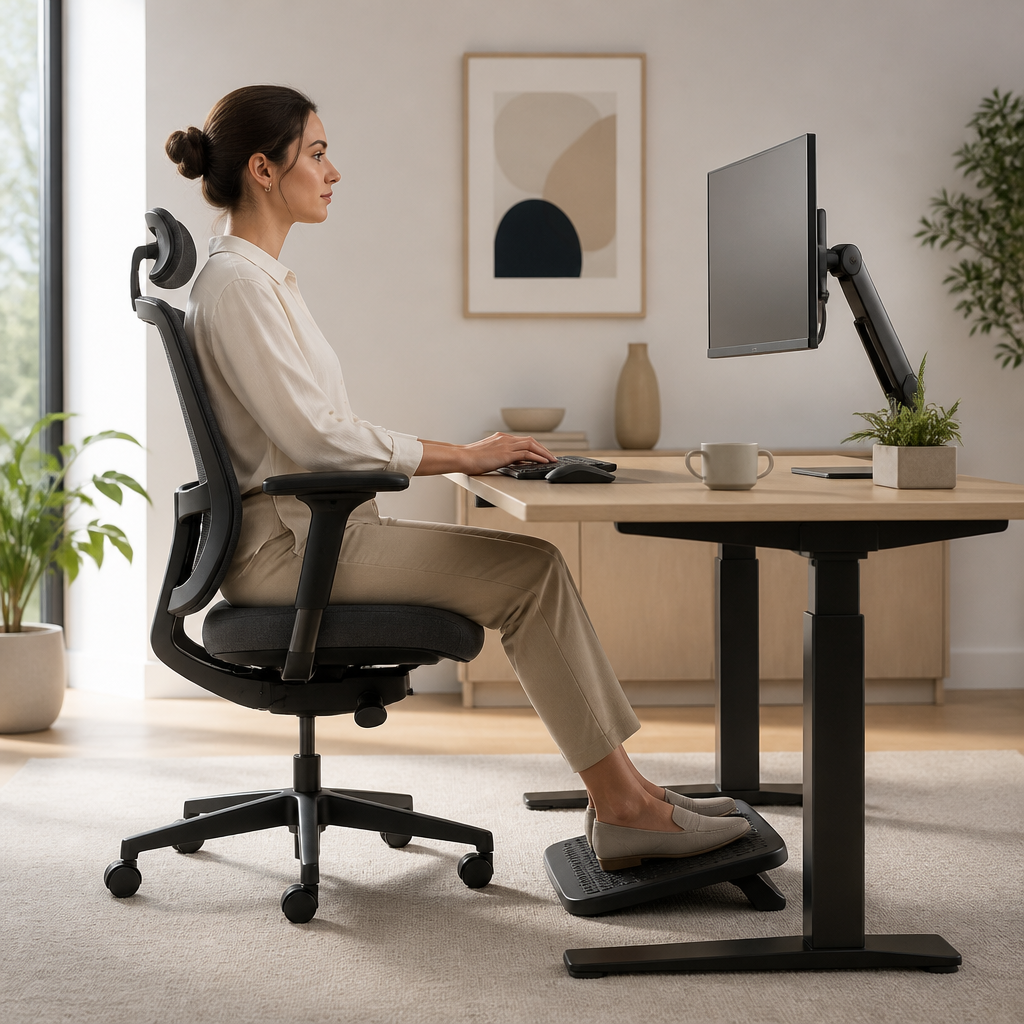
Arthritis guidance on sitting recommends keeping your back against the back of the chair, your feet flat on the floor, and a small space between the backs of your knees and the seat. In practice, adjust the chair so your thighs slope slightly down and your feet rest flat without pressure under the thighs. If your feet do not reach the floor, use a footrest rather than letting your legs dangle.
Pro tip: Check your chair height every time you change desks or shoes. Heels change the height of your feet, and a chair that felt right in flats can leave your knees sitting too high in heels.
Screen and keyboard placement
Set the top of the screen at or slightly below eye level, so you look slightly down rather than tilting your head back. Keep the keyboard close enough that your elbows stay near your sides and your wrists stay relaxed. A laptop on a desk usually puts the screen too low, so use an external keyboard and raise the screen when you can.
Pro tip: Move your chair closer to the desk rather than leaning forward to reach it. Leaning forward for an hour puts far more load on the lower back than a short, deliberate reach.
Movement Breaks That Actually Reduce Stiffness
If you change one thing this week, change how often you move. Orthopedic guidance on sitting-related stiffness points to stretching as one of the easiest and most effective ways to fight it. Stretching once in the morning, however, will not undo a day of stillness.
The two-minute stand and reset
Set a reminder to stand every 30 to 60 minutes. Stand up, roll your shoulders, take ten slow steps, and sit back down. This takes less time than checking your phone. The point is the change in position, not the length of the break.
Seated stretches for hips, hamstrings, and ankles
A seated figure-four stretch opens the hip, and a seated hamstring stretch with one leg extended eases the back of the thigh. Hold each for 20 to 30 seconds without bouncing. Ankle circles, about ten in each direction, wake up the joints that sit tucked under the chair for hours.
Why walking beats stretching alone
Stretching lengthens tissue, but walking moves the joints through their full range in a rhythm that keeps the muscles active. A five-minute walk to refill your water bottle or to a colleague's desk does more for stiffness than one long stretching session done once a day. A practical sequence is stand, walk, then stretch.
Pro tip: Before you stand up after a long session, do two or three seated hip and hamstring stretches. Your first steps will feel noticeably more comfortable than walking out cold.
Where a Joint Support Supplement Fits In
Movement and posture come first, but some people also look for daily support for joint lubrication and cartilage health. That is the category where Revit Arthro sits, and it is worth being clear about what it is for and what it is not for.

What Revit Arthro is formulated to do
Revit Arthro is a liquid joint supplement designed for daily mobility support. Its 30 mL daily formula uses Hyalutidin HC, a high-purity hyaluronic acid combined with chondroitin, which is formulated to support joint lubrication and cartilage health. It is built for the everyday pattern described in this article, from post-rest stiffness to fatigue after an active day. You can learn more on the Revit Nature website.
What a supplement cannot fix on its own
A supplement will not undo a sedentary day, correct a slumped posture, or replace a stand-up break. Treat it as one part of a routine, not the routine itself. If joint pain is severe, swollen, hot, or lasting, see a clinician rather than adding another product to the mix.
Building a daily joint routine that holds up
Take the supplement at a consistent time each day, pair it with movement breaks, and check your workstation setup once a week. Consistency matters more than dramatic changes in the first few weeks. If you take medication or have a medical condition, speak with your doctor before starting any new supplement.
Pro tip: Rate your stiffness from 1 to 10 each morning and each evening for two weeks. Patterns become clear faster than memory allows, and a written record is far more useful at a doctor's appointment than a general description.
Comparing Three Approaches to Sitting-Related Joint Stiffness
Three approaches come up most often for people trying to manage stiffness from sitting. Each targets a different part of the problem, and each has a clear limit.
Which approach to start with
Start with movement breaks because they cost nothing and address the root cause, which is stillness. Add workstation changes next, since they reduce the load during the sitting that remains. Use a daily joint support product once the first two habits are in place, so you are supporting a routine rather than covering up a habit.
| Approach | What It Targets | Where It Falls Short |
|---|---|---|
| Movement breaks every 30 to 60 minutes | Stillness and the stiffness that builds across the day | Requires consistency, and it does nothing for poor posture between breaks |
| Workstation setup (chair, screen, and feet) | Load on the lower back, neck, and hips during sitting | Cannot fix the lack of movement, since a well-set chair still means hours of stillness |
| Daily joint support supplement (for example, Revit Arthro) | Daily support for joint lubrication and cartilage health as part of a routine | Does not replace movement or posture, and results depend on using it consistently with other habits |
Frequently Asked Questions
How long can I sit before my joints start to stiffen?
There is no exact number that applies to everyone. As a practical guideline, stand and move for a minute or two every 30 to 60 minutes. Most people notice stiffness creeping in well before the end of a long session.
Is joint stiffness after sitting a sign of arthritis?
Not necessarily. Stiffness that eases after a few minutes of movement is common after sitting. Swelling, warmth, or pain that persists at rest should be checked by a clinician, because those signs point to something beyond posture.
Can a standing desk fix office joint pain on its own?
A standing desk helps only if you alternate between sitting and standing. Standing all day places its own load on the knees, hips, and feet. The best results come from changing position often, whatever the desk type.
Does a joint support supplement help with stiffness from sitting?
A daily joint support supplement may fit into a routine that includes movement and better posture. It does not replace those habits. If you have a medical condition or take medication, talk with your doctor before starting.
What is the first change I should make if my joints feel stiff at work?
Start with movement breaks, because they address the main cause, which is stillness. Once you are standing up regularly, check your chair height and foot position. Those two changes cost nothing and often make the biggest difference within the first week.
Share your experience with us: which part of your workday leaves your joints feeling worst, and what has helped you most so far?


